One platform for cybersecurity service delivery.
Druqvethyn AI helps MSSPs, MDR providers, and assessment firms run eight connected modules—Dashboard, Client Intake, Engagement Scoping, Alert Triage, Security Testing, Remediation, Compliance Review, and Client Closeout—from first request to signed handover. It documents authorized work and evidence; it does not replace your SIEM, EDR, scanners, or expert judgment.

Your practice-wide command center.
The practice-wide command center for cybersecurity service delivery—one place to see workload, risk, and who must act next.
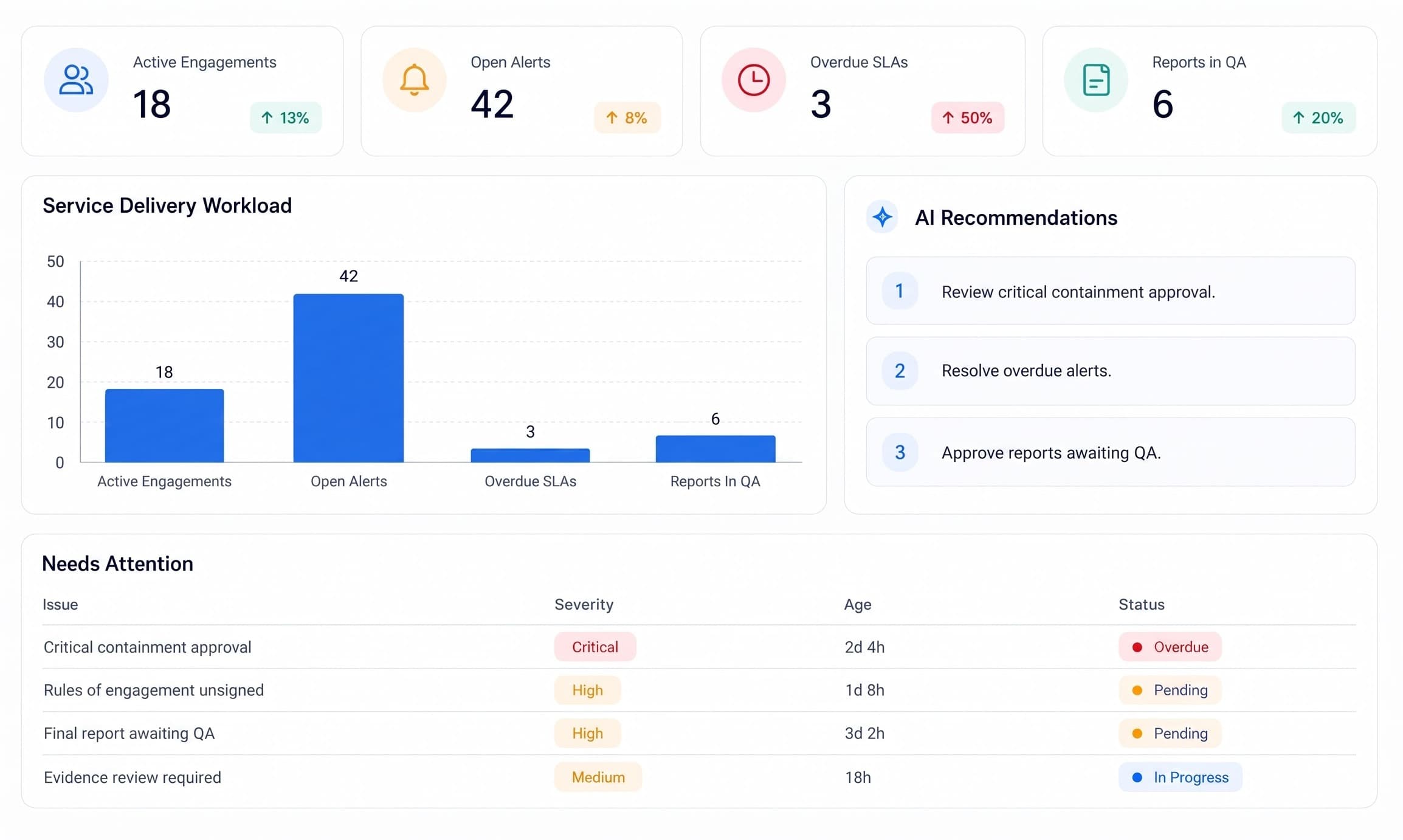
Portfolio pulse
Portfolio pulse KPI: rolling engagement load, alert volume, SLA exposure, and reports waiting on QA—so leaders see practice health without leaving the Dashboard.
Guided priorities
Guided priorities: AI-assisted recommendations for containment, overdue items, and report QA—with links into the right module until a human assigns ownership.
Needs attention
Needs attention: unsigned RoE, stalled containment, and evidence gaps surface here so delivery leaders can route work into Intake, Triage, or Closeout.
What you gain across Druqvethyn AI
AI highlights exceptions and suggests priorities with linked records; your team assigns owners and approves every decision.
Eight modules, one cybersecurity services practice.
Each workspace is a distinct part of your delivery model—not a generic app screen. AI assists inside the module; your team approves every outcome.
- Druqvethyn AI Client Intake moduleDocument
Client Intake
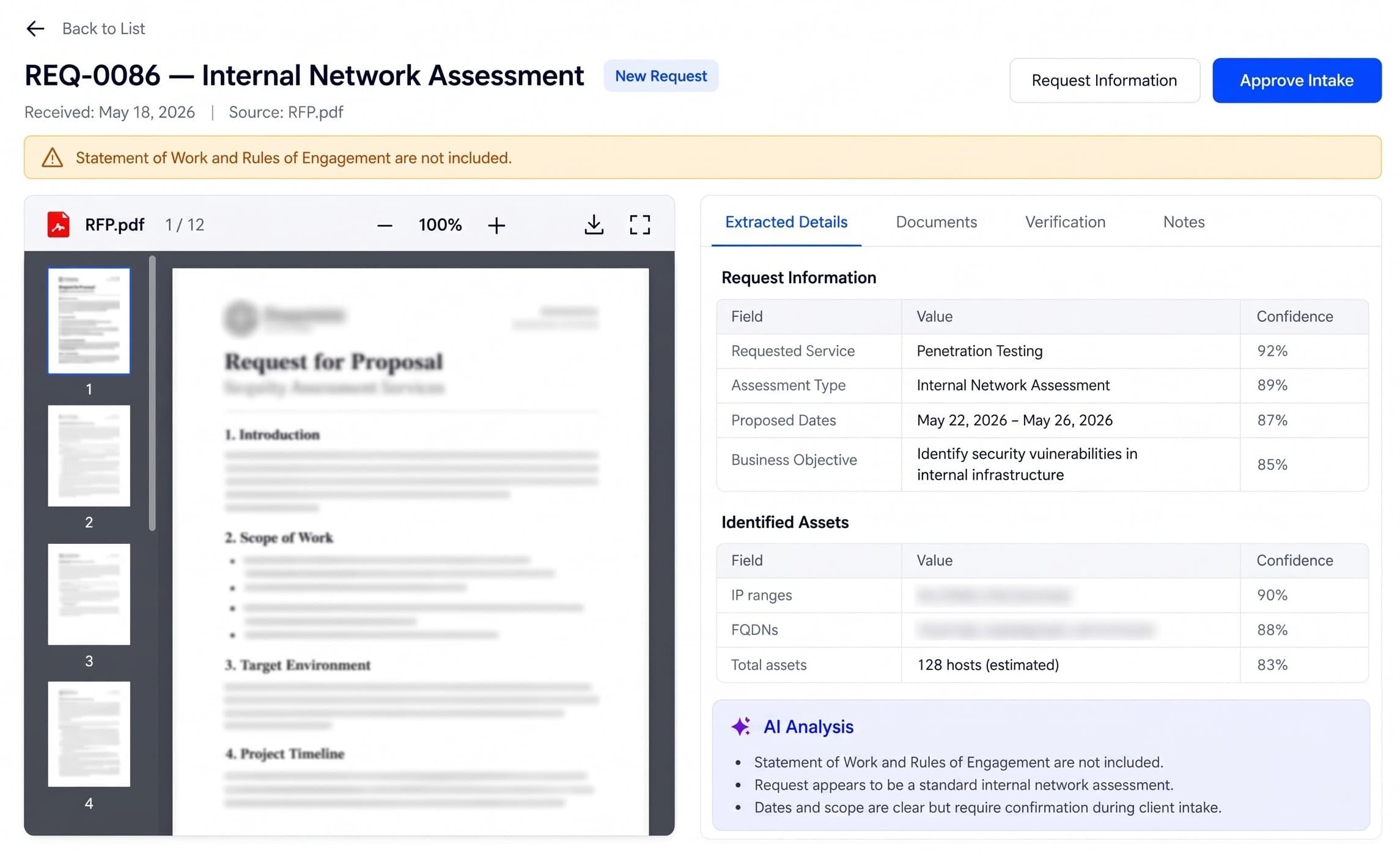
The front door for new work—turning inbound requests into qualified engagements with the right contacts and documents on file.
AI in this module. AI extracts scope, dates, and assets from RFPs and flags gaps; humans confirm ownership and authorization before scoping opens.
- Druqvethyn AI Engagement Scoping moduleMatrix
Engagement Scoping
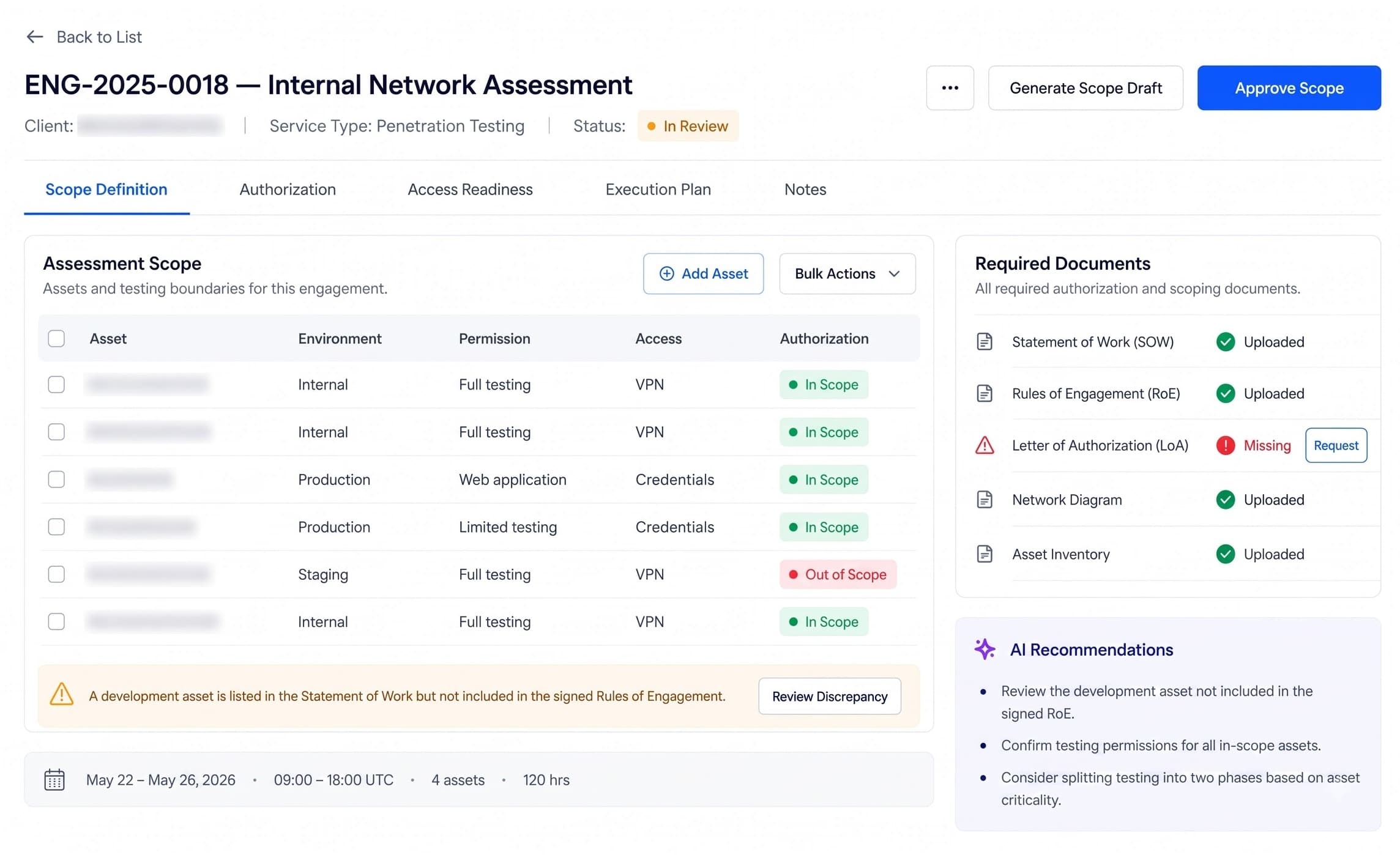
The authorization workspace—where permitted targets, techniques, and timelines are agreed before any testing or monitoring starts.
AI in this module. AI compares SOW and RoE for conflicts; execution stays blocked until signatures and access checks pass.
- Druqvethyn AI Alert Triage moduleBoard
Alert Triage
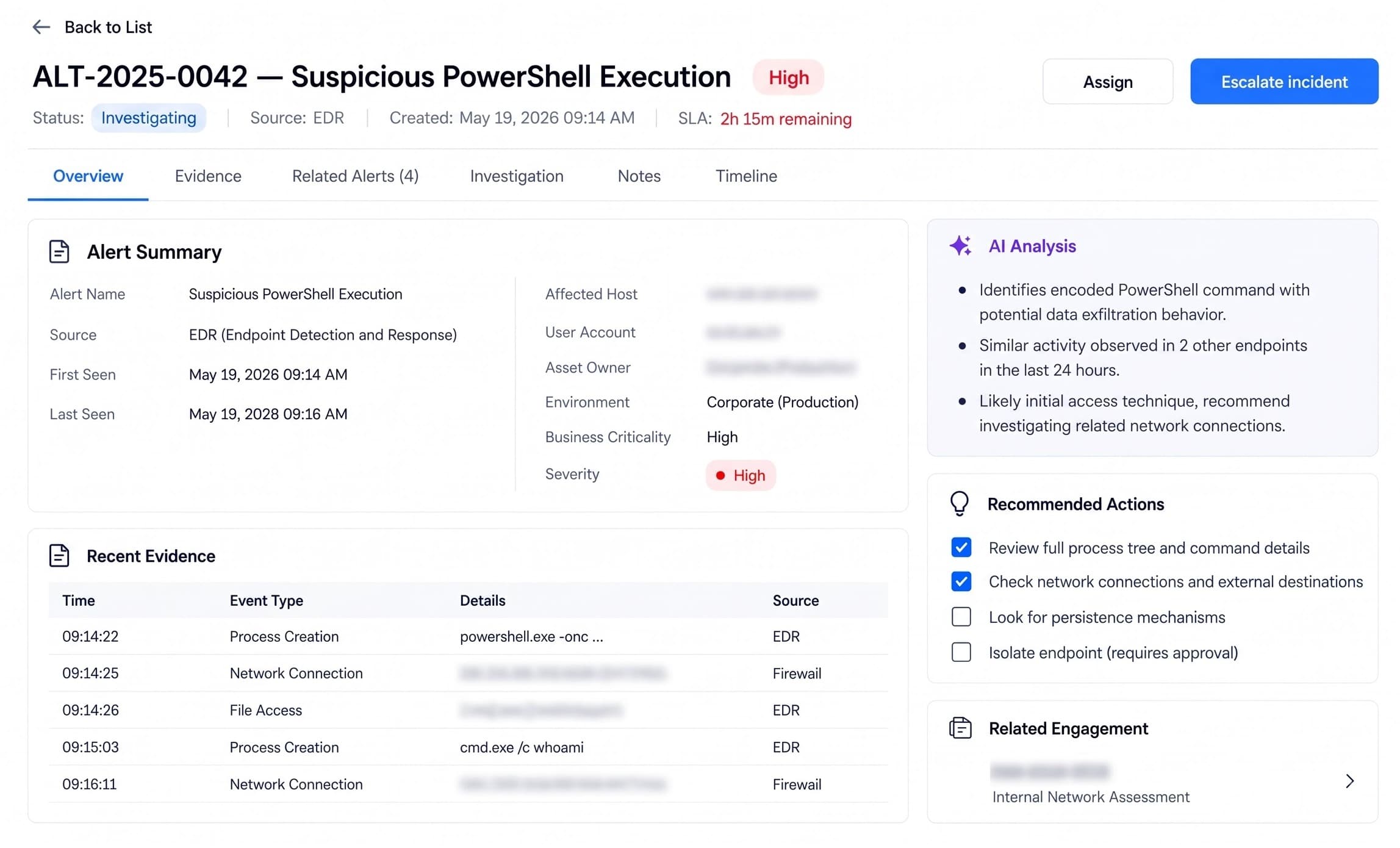
The managed-security workspace—for investigating alerts and incidents with evidence, escalation, and client-approved containment on record.
AI in this module. AI correlates telemetry and drafts investigation steps; analysts validate before any containment or client notification.
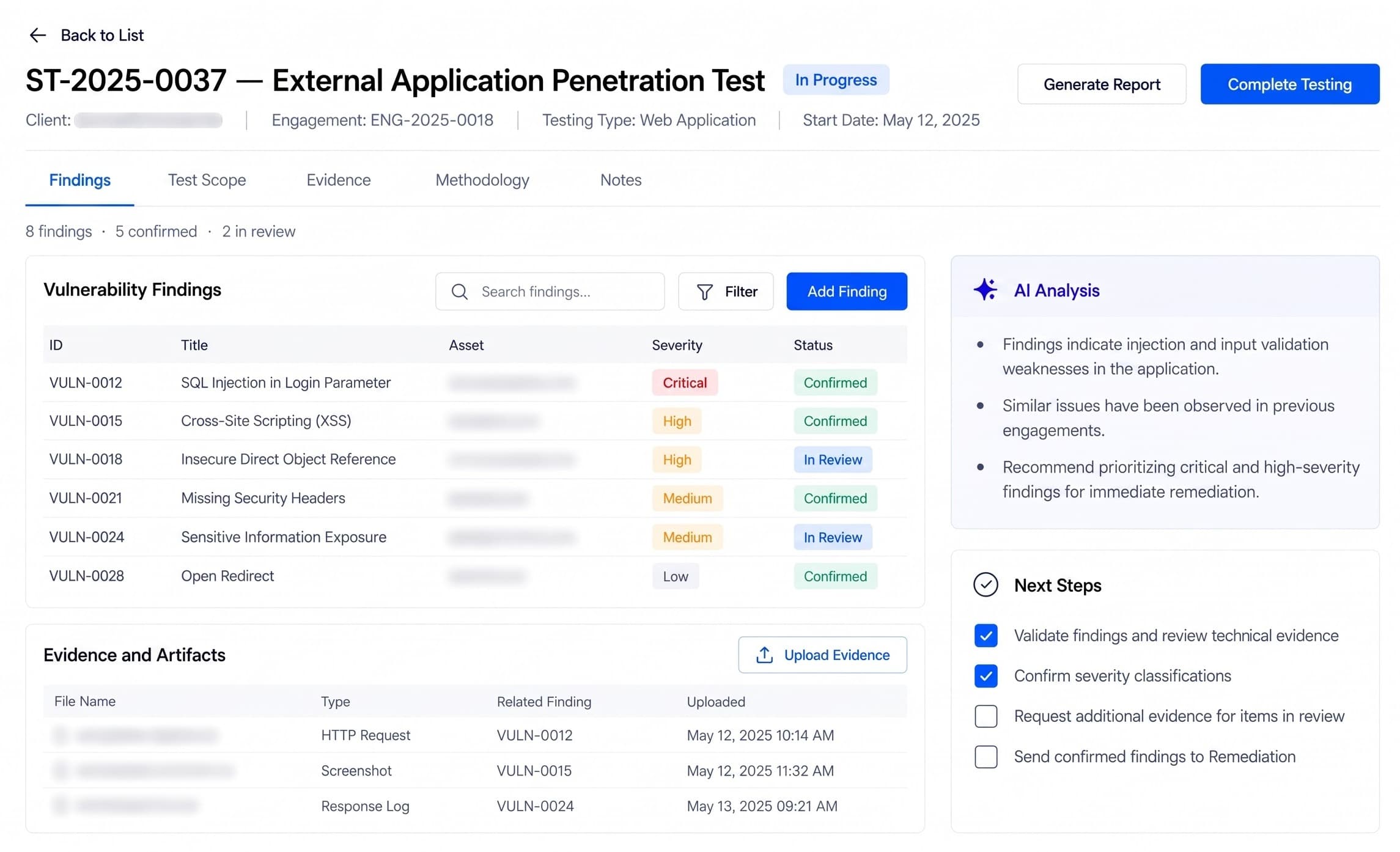
- Druqvethyn AI Security Testing moduleStudio
Security Testing
The assessment workspace—for validating findings, attaching evidence, and passing technical QA before anything reaches the client.
AI in this module. AI suggests duplicates, severity context, and remediation wording; testers and QA reviewers approve every finding.
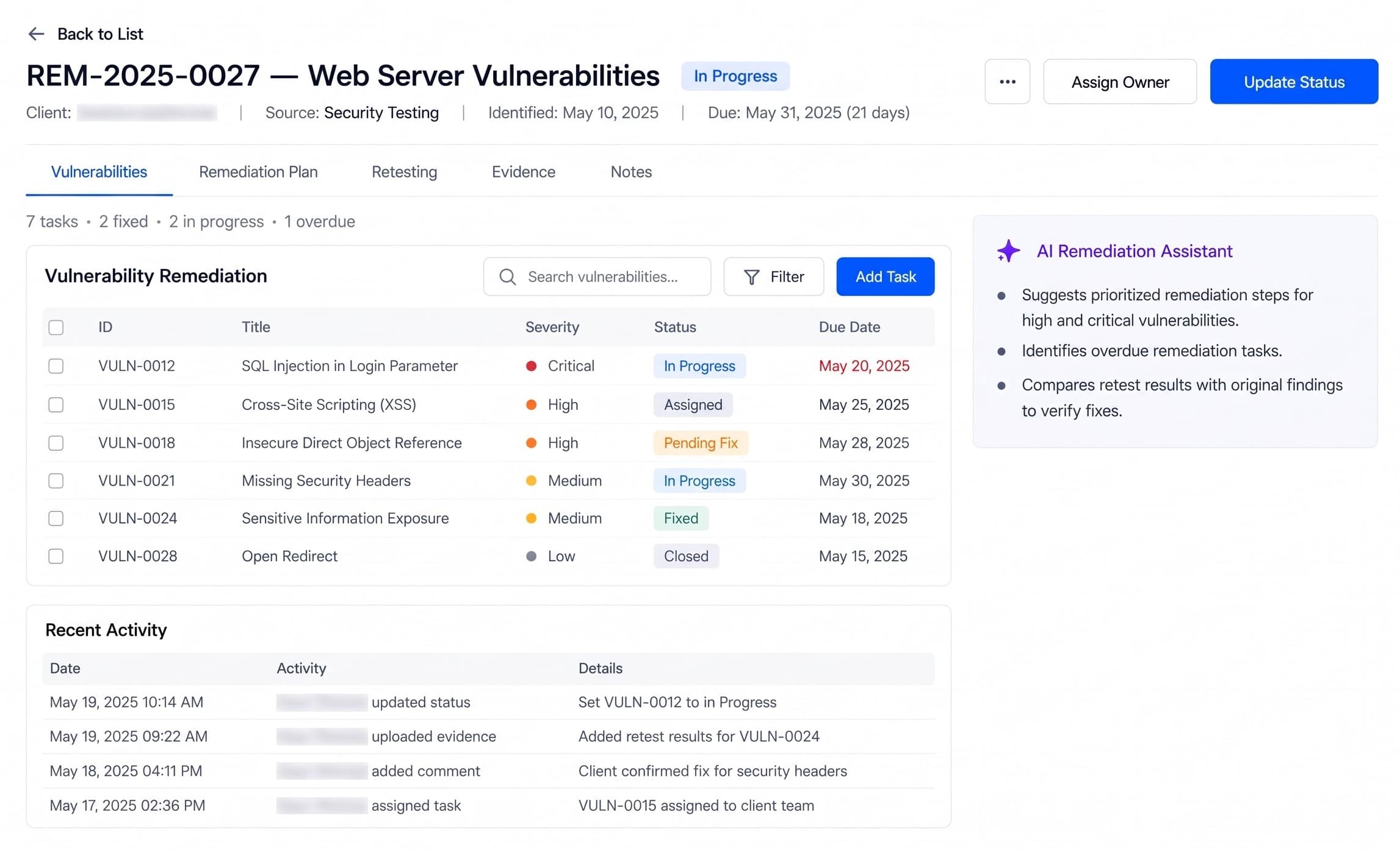
- Druqvethyn AI Remediation modulePipeline
Remediation
The verification workspace—for tracking fixes, retests, and formally accepted residual risk after a finding is validated.
AI in this module. AI prioritizes by exposure and asset criticality; client fixes only close when verification or authorized acceptance is recorded.
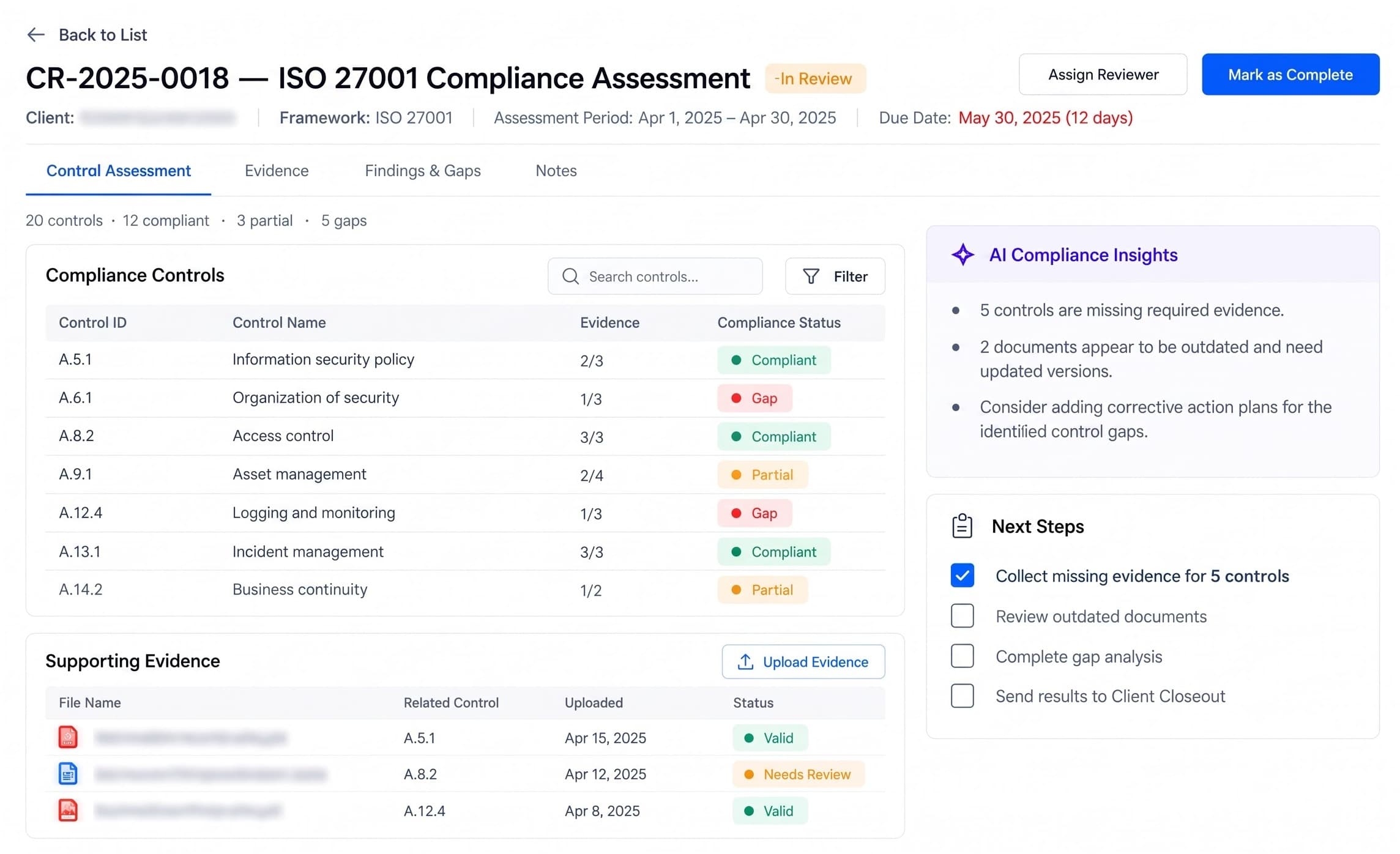
- Druqvethyn AI Compliance Review moduleMatrix
Compliance Review
The assurance workspace—for mapping evidence to controls, tracking gaps, and preparing packages auditors and clients can review.
AI in this module. AI proposes control-to-evidence links and draft assessor notes; qualified reviewers sign off on conclusions.
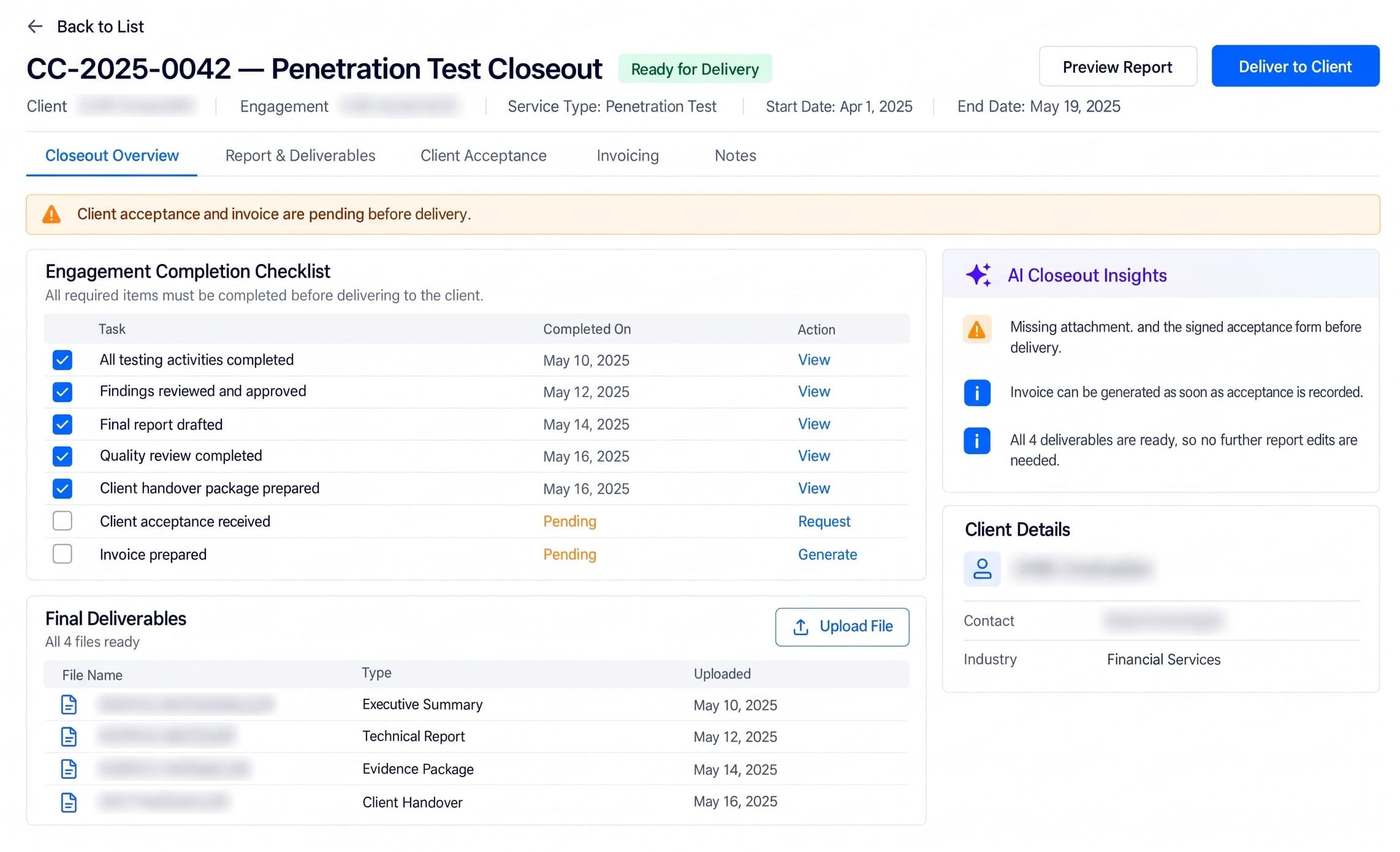
- Druqvethyn AI Client Closeout moduleDocument
Client Closeout
The handover workspace—for QA-approved deliverables, client acceptance, billing milestones, and evidence retention rules.
AI in this module. AI drafts executive summaries and checks consistency; humans approve release, acceptance, and commercial closeout.
Traditional SaaS vs Druqvethyn AI
Don't settle for the AI your software chose.
Most platforms ship one model and you work inside its limits. Druqvethyn AI puts an orchestration layer between the engagement record and the model, so intake, triage, testing, and closeout steps run on the intelligence that suits each task.
Legacy security SaaS
generic AI
Disconnected consoles with bolt-on assistants. Manual report copying, lost authorization context, and unauditable handoffs between tools.
You work within their limits.
Druqvethyn AI · Routed workflow engine
8 specialized agents- 01
Extract scope, RoE, and intake documents
Layout-aware parsing preserves SOW tables, asset lists, and authorization fields from RFPs and client packets without flattening structure into prose.
MMistralDOCUMENT AI / OCR
- 02
Classify alerts and route by SLA urgency
Intent classification separates noise, true positives, and client-escalation cases—assigning owners against response clocks in Alert Triage.
HFHugging FaceINFERENCE CLASSIFIER
- 03
Cross-check SOW, RoE, and authorization
Long-context models keep contracts, rules of engagement, and prerequisite checks in view before intrusive testing or monitoring is approved.
GGeminiLONG CONTEXT
- 04
Structured finding and IOC extraction
Constrained outputs map scanner exports and analyst notes into your finding schema with severity, asset, and evidence links ready for QA.
AIOpenAISTRUCTURED OUTPUTS
- 05
Correlate incidents and draft investigation steps
Links telemetry, identity signals, and timeline events into investigation narratives—marked as suggested until an analyst validates containment.
AClaudeFRONTIER REASONING
- 06
Prioritize remediation by exposure and criticality
Reasoning over asset context, exploitability, and client SLAs proposes fix order—client acceptance and retest still require human sign-off.
DSDeepSeekREASONING API
- 07
Map evidence to control frameworks
Retrieval proposes control-to-evidence links and draft assessor notes for Compliance Review—qualified reviewers approve conclusions.
CCohereRERANK + EMBED
- 08
Redact client-sensitive case material
Open-weight models in your VPC can mask credentials, PII, and restricted attachments before content is sent to hosted frontier APIs.
LLlamaSELF-HOSTED VPC
One authoritative service-delivery record8 modulesevidence chainhuman approval gates
Note: Model and provider names are illustrative of integration patterns; trademarks belong to their respective owners. Routing is configured per tenant and data boundary. Supported and evaluated ecosystem models include OpenAI, Anthropic / Claude, Google / Gemini, Cohere, Mistral, Meta / Llama, xAI, and DeepSeek.
How cybersecurity services teams use Druqvethyn AI
Four stages cover the full delivery lifecycle. The Dashboard stays open throughout; human approval gates every intrusive or client-facing step.
- Step 01 · Qualify & authorize
Open work the right way
Client Intake turns inbound requests into qualified engagements; Engagement Scoping locks targets, techniques, and dates before anything intrusive runs.

CLIENT INTAKE · ENGAGEMENT SCOPING - Step 02 · Investigate & test
Run the engagement
Alert Triage supports managed detection and response; Security Testing supports assessments and finding QA—often in parallel on the same client record.

ALERT TRIAGE · SECURITY TESTING - Step 03 · Assure & comply
Verify fixes and controls
Remediation tracks client fixes through retest or accepted risk. Compliance Review maps evidence to controls and maintains gap registers for auditors.

REMEDIATION · COMPLIANCE REVIEW - Step 04 · Close out & extend
Hand over and keep agents in sync
Client Closeout packages QA-approved deliverables and records acceptance. Pair the flow with Nestack Industry Agents for monitored, accuracy-checked automation alongside your modules. View Industry Agents.

CLIENT CLOSEOUT · INDUSTRY AGENTS


Industry AI agents
Your Cybersecurity Services AI agents, run like production systems.
Not chatbots. Production agents embedded in intake, triage, testing, and closeout workspaces — with evidence references, confidence limits, and reviewer accountability built in.
- 01Authorized scopeEngagement
A penetration test or managed-detection engagement starts only after RoE, LoA, and asset boundaries are recorded in Engagement Scoping.
- 02Investigation agentAI agents
Correlates alerts or scanner output, drafts investigation questions, suggests priority, and links evidence — marked as suggested until an analyst validates.
- 03SIEM · scanners · PSAConnected tools
Ingests approved exports and API data from the stack you already operate; writes tickets, findings, and report sections back.
- 04Human approvalExecution
Containment, intrusive testing, risk acceptance, and client deliverables require accountable approval — no autonomous production changes.
- 05Traceable handoverOutcome
Every finding traces to engagement, scope, asset, reviewer, remediation, and final report for audits and client disputes.
Tools & integrations
Your entire security stack, connected.
Connects to your SIEM, EDR, vulnerability scanners, PSA, identity, and collaboration tools through documented APIs. Druqvethyn AI ingests approved exports and writes outcomes back—your instruments stay the system of record for telemetry and detections.
Note: Tool names and marks belong to their respective owners. No endorsement or partnership implied. Integration availability depends on your existing systems, licences, API access, security configuration and implementation scope.
Security Standards & Framework Alignment
Druqvethyn AI helps cybersecurity service teams organize assessment evidence, track control gaps, document incidents, and prepare review-ready reports aligned with recognized security standards and frameworks. Our platform supports the assessment process. Certification, independent audit opinions, legal compliance decisions, and regulatory submissions remain the responsibility of authorized professionals and relevant organizations.
Note: These are standards the platform is built to support inside your workflows — obligations that fall on you as the licensee. They are not certifications held by us, and support in the product is not a substitute for your own counsel or compliance officer.
Add the hardware your workflow needs.
Optional third-party devices connect through documented interfaces when clients need on-prem collection or physical telemetry alongside Druqvethyn AI.
Note: Hardware, installation, and integration are not included in the standard subscription. Additional charges apply based on the hardware selected, integration modules required, and implementation scope.
One plan. The whole service-delivery stack.
One subscription for the entire platform — every module from Client Intake through Engagement Scoping, Alert Triage, Security Testing, Remediation, Compliance Review, and Client Closeout. No per-module add-ons to decode.
- core modules in one workspace
- 8
- core modules in one workspace
- subscription for the whole platform
- 1
- subscription for the whole platform
- operational stages from intake to closeout
- 5
- operational stages from intake to closeout
Starting at
$200/mo
Full platform access
Every module of Druqvethyn AI — authorization, evidence-backed findings, and client handover in one workspace. Talk to us about your service portfolio.
Note: AI API usage is charged separately. Clients must recharge their AI credit balance based on their usage.
What your onboarding fee covers
A one-time setup that establishes your service-delivery foundation before the first monthly cycle — tenant workspaces, client roster, authorization templates, approved integrations, and triage rules aligned to your engagement types. Each fee below is a starting point; final scope depends on client count, integrations, telemetry volume, compliance frameworks, and deployment model.
Two ways to run the platform
Your subscription stays the same either way — only the one-time onboarding may differ by requirements.
Cloud (SaaS)
Nestack-managed hosting with scaling, updates, and backups. Fastest path for MSSPs connecting client tools through approved exports and APIs.
Private / self-hosted
Same platform in your cloud, VPC, or on-prem when client contracts or data residency require evidence to stay in your environment. Monthly subscription unchanged.
Questions service providers ask before the demo
Pricing, stack fit, AI accountability, data handling, integrations, compliance evidence, and onboarding — without overpromising outcomes.
Ask us something elseDruqvethyn AI is designed for cybersecurity service teams managing multiple clients, assessments, incidents, and security deliverables. Pricing should reflect your team's size, operational requirements, and selected capabilities. Request a tailored quote to understand subscription costs and any applicable usage, onboarding, or integration charges before committing.
No. Druqvethyn AI is designed to work alongside your existing security tools, not replace them. It helps your analysts turn security findings, incident evidence, and assessment results into organized investigations, remediation records, compliance reviews, and client-ready reports.
Druqvethyn AI is designed to reduce repetitive work such as reviewing duplicate findings, compiling technical reports, organizing assessment evidence, tracking remediation, and preparing client deliverables. Your analysts remain responsible for validating findings and making security decisions, while AI assists with documentation, prioritization, and review.
AI-generated results are recommendations, not automatically verified security conclusions. Druqvethyn AI is designed to preserve supporting evidence and allow qualified analysts to review findings, severity classifications, remediation guidance, and reports before approval. Your team retains control over security decisions.
Cybersecurity engagements involve confidential network details, vulnerability evidence, and incident records. Druqvethyn AI is designed around client-level data separation, role-based access, and controlled evidence handling. Before subscribing, request confirmation of the implemented encryption, data retention, hosting, subprocessors, and security controls applicable to your deployment.
The product is designed to use approved security evidence from vulnerability scanners, monitoring systems, endpoint tools, and existing operational workflows. Integration availability depends on the specific tool and supported import or API method. Share your current security stack to confirm compatibility and any integration work required before purchasing.
Yes, through evidence preparation and review workflows. Druqvethyn AI is designed to help teams organize evidence, map findings to applicable controls, identify missing documentation, and prepare assessment packages supporting frameworks such as ISO 27001, SOC 2, NIST CSF, and CIS Controls. It does not replace independent auditors, issue certifications, or guarantee regulatory compliance.
Onboarding requirements depend on your team size, security workflows, client structure, and data integration needs. Initial setup may include user access, client engagement configuration, document imports, and workflow verification. Confirm the available onboarding assistance, implementation scope, and estimated deployment timeline before subscribing.